- Clocked Above 10 m/s Televised and treadmill demonstrations recorded 10.3 to 10.4 metres per second, with a manufacturer peak figure of 13.4 metres per second after later upgrades.
- 13.17 Seconds over 100 Metres The robot covered 100 metres from a standing start on an athletics track, an unofficial mark set in a live broadcast.
- Jerboa-Inspired Carbon Shins The lower legs raise stiffness by 135 percent for 16 percent more mass, and a later revision merged three parts into one piece.
- Energy-Returning Knee Springs Springs between the knee joints absorb each impact and return that energy to the next stride, in the manner of a tendon.
- Five Strides per Second Peak stride frequency reaches five steps per second, the cadence behind the sprint figures.
- Machine-Learned Gait Gait control adapts in real time, which is what keeps the motion fluid rather than stepped at those speeds.
- 38 kg at 0.63 m Carbon-fibre construction keeps mass low enough for the accelerations the legs have to survive.

Description
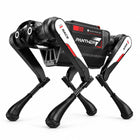
The Black Panther II is the quadruped that took the four-legged speed record away from Boston Dynamics' WildCat. Weighing 38 kilograms and standing 0.63 metres, it was clocked at 10.3 to 10.4 metres per second in televised and treadmill demonstrations and covered 100 metres from a standing start in 13.17 seconds on an athletics track in Wuhan. MirrorMe reports a peak of 13.4 metres per second after later upgrades.
The speed is the sum of a lot of small decisions rather than one trick. The shins are carbon fibre modelled on the jerboa, 135 percent stiffer for 16 percent more mass, and a later revision merged three lower-leg parts into a single piece. Springs between the knee joints behave like tendons, storing the energy of each footfall and returning it to the next stride, while rubber feet modelled on the animal keep traction at cadence.
Control is where the research value sits. Machine learning adapts the gait in real time, and MirrorMe wrote its own legged-robot design software to support the programme. For a laboratory studying high-speed locomotion, actuator limits or bio-inspired mechanics, this is a platform already operating at the edge of the envelope rather than one that has to be pushed there first.
Payload, runtime and ingress protection are confirmed with the quotation. The usual buyers are universities, corporate R&D groups benchmarking control policies, and science centres and events where a sprinting quadruped draws a crowd. The robot is also referred to as the Black Panther 2.0; both names mean the same machine.
Key Capabilities
- Clocked Above 10 m/s: Televised and treadmill demonstrations recorded 10.3 to 10.4 metres per second, with a manufacturer peak figure of 13.4 metres per second after later upgrades.
- 13.17 Seconds over 100 Metres: The robot covered 100 metres from a standing start on an athletics track, an unofficial mark set in a live broadcast.
- Jerboa-Inspired Carbon Shins: The lower legs raise stiffness by 135 percent for 16 percent more mass, and a later revision merged three parts into one piece.
- Energy-Returning Knee Springs: Springs between the knee joints absorb each impact and return that energy to the next stride, in the manner of a tendon.
- Five Strides per Second: Peak stride frequency reaches five steps per second, the cadence behind the sprint figures.
- Machine-Learned Gait: Gait control adapts in real time, which is what keeps the motion fluid rather than stepped at those speeds.
- 38 kg at 0.63 m: Carbon-fibre construction keeps mass low enough for the accelerations the legs have to survive.
Buying through Robotix Market
This unit is sourced new through established distribution channels and ships worldwide with the manufacturer warranty. Technical support is coordinated with the manufacturer's own service network. Deployment scope, configuration, and commissioning responsibilities are agreed as part of the quotation — on-site installation is not included in the product price.
Features
Specs
| Brand | MirrorMe |
|---|---|
| Manufacturer | MirrorMe Technology, Shanghai |
| Model | Black Panther II (also called Black Panther 2.0) |
| Product Type | High-speed quadruped robot |
| Weight | 38 kg |
| Height | 0.63 m |
| Tested Top Speed | 10.3-10.4 m/s in televised and treadmill demonstrations |
| Manufacturer Peak Speed | 13.4 m/s following later upgrades |
| 100 m Sprint | 13.17 s from a standing start |
| Peak Stride Frequency | 5 steps per second |
| Leg Construction | Single-piece carbon-fibre lower legs |
| Knee Design | Integrated springs for shock absorption and energy return |
| Feet | Rubber, panther-inspired tread |
| Control | AI and machine-learning gait adaptation |
| Payload | Confirm at quote |
| Runtime | Confirm at quote |
| Ingress Protection | Confirm at quote |
Industries
Frequently Asked Questions
It was clocked at 10.3 to 10.4 metres per second in televised and treadmill demonstrations and ran 100 metres from a standing start in 13.17 seconds. MirrorMe reports a peak of 13.4 metres per second after later upgrades.
Yes. Both names refer to the same quadruped, which has been revised several times since its January 2025 unveiling.
Jerboa-inspired carbon-fibre lower legs, energy-storing knee springs, rubber feet, compact high-output motors and a machine-learned gait that adapts stride by stride.
It weighs 38 kilograms and stands 0.63 metres tall.
The payload rating and runtime are both confirmed with the quotation.
The MirrorMe Black Panther II Quadruped Robot is priced at QAR 466,500 in your market.
Recently Viewed
You haven't viewed any products yet.